By Shivam Yoga Centre | Holistic Wellness & Yoga Science
You wake up exhausted after eight hours in bed. You sit through back-to-back meetings, answer a hundred emails, hit every deadline — and still feel like you’re running on empty. Sound familiar?
If you’ve been living that relentless corporate cycle long enough, your body and mind have likely started sending distress signals. And no, that third cup of coffee isn’t going to fix it.
Corporate burnout is real, it’s widespread, and it’s quietly stealing the health, creativity, and joy from millions of working professionals every single day. The good news? There’s an ancient, scientifically backed practice that can pull you back from the edge — and it doesn’t require a gym membership, a vacation, or two free hours in your already-packed schedule.
It’s called Yoga Nidra, and at Shivam Yoga Centre, we’ve watched it transform the lives of corporate professionals who walked through our doors carrying years of accumulated stress on their shoulders.
Let me tell you everything you need to know.
What Exactly Is Corporate Burnout — And Why Is It Getting Worse?
Before we talk solutions, let’s understand the problem clearly.
The World Health Organization officially classified burnout as an occupational phenomenon in 2019. It’s defined by three characteristics:
- Emotional exhaustion — feeling drained, depleted, and unable to cope
- Depersonalization — growing cynical, detached, or indifferent toward your work and the people around you
- Reduced personal accomplishment — a persistent feeling that nothing you do is ever enough
But here’s what most people miss: burnout doesn’t happen overnight. It’s the slow accumulation of chronic, unmanaged stress. It builds quietly, one skipped lunch break, one late-night work call, one cancelled family dinner at a time.
The modern corporate lifestyle is practically designed to trigger it. You’re dealing with:
- Constant digital connectivity — the workday never truly ends
- Performance pressure — quarterly targets, appraisal cycles, and the fear of falling behind
- Emotional labour — managing office politics, client expectations, and team dynamics simultaneously
- Sedentary behaviour — hours hunched over a screen, disconnected from your own body
- Sleep disruption — overthinking at midnight, checking emails at 6 a.m.
Over time, your nervous system gets locked in a state of chronic fight-or-flight. Cortisol (your primary stress hormone) stays elevated. Your sleep quality deteriorates. Your immune system weakens. Anxiety becomes your baseline state, not an occasional visitor.
This isn’t weakness. It’s biology responding to an unsustainable environment.
Warning Signs You’re Already Burning Out (And Probably Brushing Off)
Most corporate professionals I’ve worked with over the years say the same thing when they first come to class: “I didn’t realize how bad it had gotten.”
Burnout doesn’t announce itself with a dramatic breakdown. It whispers. Then it starts shouting. Here are the signs to watch for:
Physical Signs
- Persistent fatigue, even after sleep
- Frequent headaches, neck tension, or lower back pain
- Digestive issues — bloating, IBS, acidity
- Getting sick more often than usual
- Heart palpitations or a tight chest with no medical cause
Mental & Emotional Signs
- Difficulty concentrating or making simple decisions
- Feeling emotionally numb or inexplicably sad
- Short temper and low tolerance for frustration
- Loss of enthusiasm for things you used to enjoy
- A nagging sense of dread before every workday
Behavioural Signs
- Procrastinating on tasks that were once effortless
- Withdrawing from colleagues, friends, or family
- Relying on caffeine, alcohol, or binge-watching to “unwind”
- Working longer hours but producing less
If you’re nodding at three or more of these, yoga isn’t just a good idea for you. It’s urgent.
Why a Weekend Off (Or a Vacation) Won’t Fix Burnout
Here’s the hard truth most productivity gurus won’t tell you: rest alone doesn’t heal burnout.
You can take a two-week holiday, sleep 10 hours a night, and still return to work feeling exactly as drained as when you left. Why? Because burnout isn’t just about physical tiredness. It’s a dysregulation of your entire nervous system.
Your stress response has been overactivated for so long that your body has forgotten how to switch off. The sympathetic nervous system (responsible for stress responses) is chronically dominant. The parasympathetic nervous system (responsible for rest, repair, and recovery) has become weak and underused.
Conventional stress-relief strategies — a walk in the park, a massage, even a regular yoga class — help. But they often don’t go deep enough to truly reset the system.
That’s where Yoga Nidra does something nothing else quite can.
Yoga Nidra: The Ancient Science of Conscious Sleep
Yoga Nidra, often translated as “yogic sleep,” is one of the most profound and misunderstood practices in the yoga tradition.
It isn’t sleep. It isn’t meditation in the conventional sense. It occupies a unique middle ground — a state of consciousness between waking and deep sleep, where the body is completely relaxed but the mind remains quietly aware.
This state, known as the hypnagogic state, is where the real magic happens.
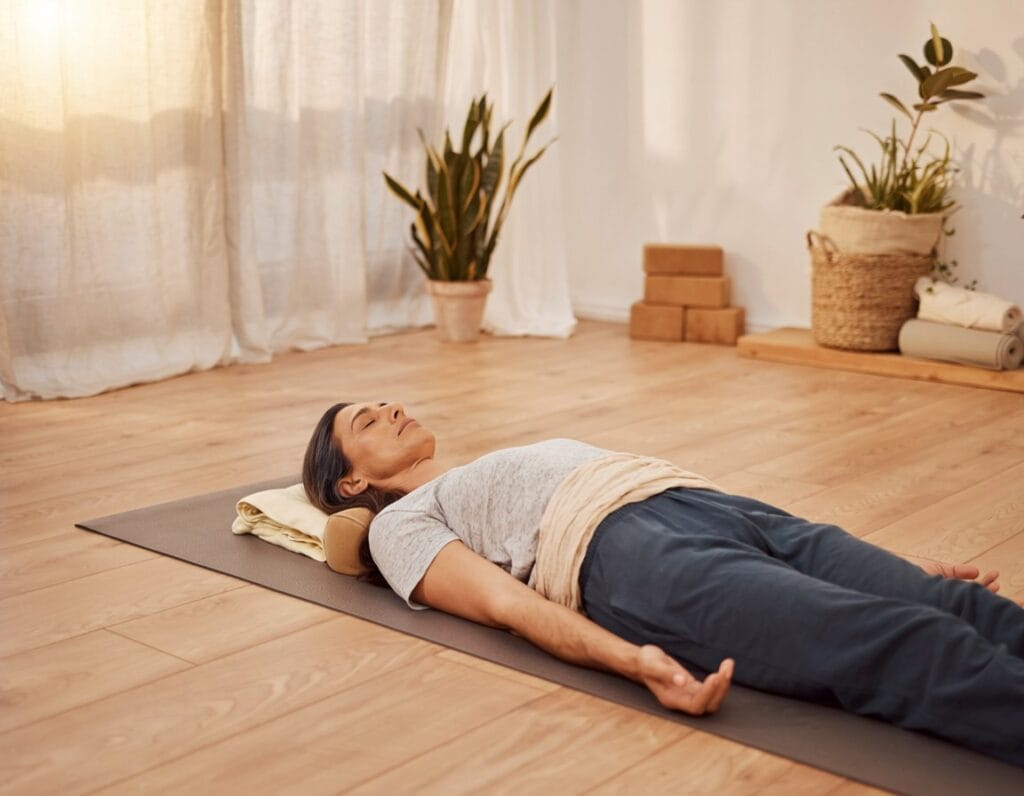
Yoga Nidra is a systematic, guided practice typically lasting 20 to 45 minutes. You lie down in Shavasana (corpse pose) — yes, you literally just lie still — while a teacher guides you through layers of progressive relaxation: body awareness, breath awareness, sensation, imagery, and finally, a deep stillness.
It sounds deceptively simple. The effects are anything but.
At Shivam Yoga Centre, we introduce corporate clients to Yoga Nidra as part of our holistic stress management programmes, and the feedback is consistently the same: “That one session felt like three nights of real sleep.”
There’s actually science behind that.
The Neuroscience Behind Yoga Nidra and Stress Recovery
This isn’t spiritual talk. This is measurable, documented biology.
Research published in peer-reviewed journals has shown that a regular Yoga Nidra practice can:
- Lower cortisol levels significantly — the stress hormone responsible for that wired-and-tired feeling
- Activate the parasympathetic nervous system, shifting the body into rest-and-digest mode
- Increase theta brainwave activity — the brain state associated with deep creativity, emotional processing, and healing
- Improve sleep architecture — particularly slow-wave sleep, the most restorative phase
- Reduce symptoms of anxiety and depression in clinical populations
A 2018 study published in the Indian Journal of Physiology and Pharmacology found that participants who practised Yoga Nidra for 30 minutes showed a significant reduction in blood pressure, heart rate, and stress markers compared to a control group.
The ancient yogic texts knew this intuitively. Modern neuroscience is now confirming it methodically.
How Yoga Nidra Specifically Heals Corporate Burnout
Let’s get specific. Here’s what Yoga Nidra does, layer by layer, to address the core mechanisms of corporate burnout:
1. It Physically Resets the Nervous System
During a Yoga Nidra session, your heart rate slows, your blood pressure drops, and your muscles release tension they’ve been holding for hours — sometimes days. The body enters a state of physiological repair that most people only access during deep sleep. But unlike sleep, you’re conscious enough to benefit from the mental aspects simultaneously.
2. It Breaks the Cycle of Mental Chatter
One of burnout’s cruelest symptoms is the inability to stop thinking — even when you’re exhausted. Yoga Nidra systematically quiets the prefrontal cortex’s overactivity by anchoring awareness in body sensation and breath. You’re not trying to stop thoughts; you’re simply giving the mind something more nourishing to attend to.
3. It Processes Suppressed Emotional Residue
Years of corporate stress create what yoga science calls samskaras — deep impressions in the subconscious mind. Unprocessed grief, frustration, and anxiety don’t disappear; they accumulate. The theta state reached in Yoga Nidra allows these stored emotional patterns to surface gently and dissolve, without the drama of forced confrontation.
4. It Restores the Sense of Self
Burnout strips away your sense of identity beyond your job title. Yoga Nidra, particularly through the use of a Sankalpa (a personal intention or resolve), reconnects you with what actually matters to you — your values, your energy, your sense of purpose. Many practitioners describe a gradual return of joy, clarity, and motivation after consistent practice.
5. It Builds Stress Resilience Over Time
This is crucial: Yoga Nidra isn’t just a temporary fix. With regular practice, it trains the nervous system to recover faster from stress. You don’t necessarily avoid stressful situations — that’s not realistic in a corporate environment — but your baseline changes. You bounce back quicker. You stay centred longer.
A Simple Yoga Nidra Practice to Start Tonight
You don’t need to come to class to begin. Here’s a basic framework you can follow:
Time required: 20–30 minutes
What you need: A quiet space, a yoga mat or firm bed, a blanket, and an eye pillow (optional but wonderful)
Step 1: Set Up (2 minutes)
Lie flat on your back in Shavasana. Let your feet fall naturally apart. Rest your arms slightly away from your body, palms facing up. Close your eyes. Take three slow, deep breaths and consciously let go of the day.
Step 2: Set Your Sankalpa (1 minute)
Bring a short, positive resolve to your mind — something deeply personal and meaningful. “I am at peace,” or “I am healthy and whole,” or “I trust myself.” State it silently three times with full feeling. Plant it like a seed.
Step 3: Body Rotation (5–7 minutes)
Move your awareness systematically through every part of your body without physically moving. Right thumb… right index finger… middle finger… palm… wrist… forearm… Continue through the entire body. This rapid rotation of awareness begins withdrawing the mind from external concerns.
Step 4: Breath Awareness (3–5 minutes)
Simply observe your natural breathing. Don’t control it. Feel the rise and fall of the chest and belly. Count breaths backward from 27. If you lose count, begin again from 27. No frustration — just begin again.
Step 5: Visualization (5 minutes)
Allow simple images to arise: a deep blue sky, a candle flame, a peaceful forest, a vast ocean. Don’t hold onto them; let them flow. This engages the right hemisphere of the brain and deepens the theta state.
Step 6: Return to Sankalpa (1 minute)
Repeat your personal resolve three times again — now the mind is deeply receptive, and the intention lands at a much deeper level.
Step 7: Gentle Awakening (2 minutes)
Begin to deepen your breath. Wiggle fingers and toes slowly. Stretch gently. Roll to one side before sitting up. Take your time. Don’t rush back into the world.
Other Yoga Practices That Supercharge Your Burnout Recovery
At Shivam Yoga Centre, we take an integrated approach to wellbeing. Yoga Nidra is the centrepiece for burnout recovery, but pairing it with these complementary practices amplifies results significantly:
Pranayama (Breathwork)
- Nadi Shodhana (Alternate Nostril Breathing): Balances the left and right hemispheres of the brain. Extraordinary for anxiety relief. Practice for 10 minutes before bed.
- Bhramari (Humming Bee Breath): The vibration directly stimulates the vagus nerve, triggering the parasympathetic response almost immediately.
- Extended exhale breathing (4-7-8): Inhale for 4 counts, hold for 7, exhale for 8. One of the fastest ways to manually calm an overactive nervous system.
Restorative Yoga
Unlike power yoga or vinyasa, restorative yoga uses props to hold passive poses for 5–10 minutes each. The nervous system benefits are similar to Yoga Nidra. Even one 45-minute restorative class per week makes a measurable difference.
Mindful Asana Practice
A gentle, body-aware asana practice — especially postures that open the chest, release the hip flexors, and decompress the spine — physically undoes the damage a desk job does to your body. We’re talking about the postures your body craves, not a workout you endure.
Daily Meditation
Even 10 minutes of simple breath-focused meditation done consistently is more effective than an hour done occasionally. The cumulative effect on the brain’s stress-response circuits is well-documented.
What to Realistically Expect from a Yoga Nidra Practice
I want to set honest expectations here, because yoga teachers who promise overnight transformation do a disservice to both the practice and the student.
In the first 1–2 weeks:
Most people fall asleep in their first few sessions — and that’s perfectly fine. Your body is catching up on a sleep debt it’s been carrying. Don’t resist it. The practice still works.
By weeks 3–4:
You start staying conscious during sessions. You notice the quality of your sleep improving. Morning grogginess begins to lift. You might feel emotional during or after practice as stored tension releases.
By month 2:
Cortisol-driven reactivity starts to reduce. Colleagues, clients, and family members often notice a change before you do — you’re simply less reactive. Decision-making feels clearer.
By month 3 and beyond:
A new baseline is established. You still experience workplace stress, but it no longer accumulates the way it once did. You have a reliable tool to reset yourself, and you use it instinctively.
Consistency is everything. Twenty minutes of Yoga Nidra practiced five days a week beats a single two-hour session once a month.
The Holistic Perspective: Yoga Isn’t Just Exercise, It’s a Way of Life
As a yoga practitioner and teacher with over two decades of experience working with students from every walk of life — corporate professionals, athletes, new mothers, retirees — I can tell you with complete conviction: the greatest shift doesn’t happen on the mat.
It happens in the boardroom when you choose a conscious breath over a reactive email. It happens at 11 p.m. when you choose Yoga Nidra over doomscrolling. It happens when you start treating rest not as laziness but as biological intelligence.
Yoga’s ancient framework of Panchakoshas (the five layers of being — physical, energetic, mental, intellectual, and blissful) teaches us that burnout isn’t just a physical or mental problem. It’s a whole-being disconnection. And whole-being problems require whole-being solutions.
That’s what a genuine yoga practice offers. Not a quick fix, but a genuine, sustainable reorientation of how you live and relate to yourself.
Your Next Step: You Don’t Have to Keep Running on Empty
Corporate life isn’t going anywhere. Deadlines, deliverables, and demanding workplaces will continue to be part of your reality. But suffering through burnout doesn’t have to be.
At Shivam Yoga Centre, we offer dedicated programmes for working professionals — including guided Yoga Nidra sessions, corporate wellness workshops, and personalised holistic wellness consultations designed around your schedule and your specific stressors.
You don’t need to overhaul your life. You need to start showing up for yourself with the same dedication you show up for your work.
Start with twenty minutes tonight. Lie down. Breathe. Let go.
Your nervous system already knows how to heal — it just needs the right conditions and the right guidance.
👉 Visit us at sycyoga.com to explore our upcoming Yoga Nidra sessions, corporate wellness programmes, and beginner yoga classes. Your first step toward genuine, lasting recovery starts here.
Key Takeaways
- Corporate burnout is a nervous system disorder, not just tiredness — rest alone won’t heal it
- Yoga Nidra reaches the theta brainwave state, enabling deep neurological repair not accessible through conventional sleep
- Regular practice lowers cortisol, activates the parasympathetic nervous system, and rebuilds stress resilience
- Combine Yoga Nidra with pranayama, restorative yoga, and mindful asana for comprehensive burnout recovery
- Consistency beats intensity — 20 minutes daily creates lasting neurological change
- Yoga offers a whole-being approach to healing, addressing the physical, mental, and emotional roots of burnout simultaneously
Written by the teaching team at Shivam Yoga Centre — guiding individuals toward authentic holistic wellness since our founding. We blend ancient yogic wisdom with contemporary understanding of stress science to deliver results that are both deeply felt and measurably real.